A number of my Republican friends love to bring up the negative effect that Obamacare is having on workers. If you like theoretical arguments, there’s CKE Restaurants CEO Andrew Puzder arguing that Obamacare inevitably brings about a shift of full time workers to part time work. In a poll of 603 smallish business owners, 41% said they had frozen hiring because of Obamacare. For people who prefer to stick with anecdotal evidence, there’s a guy who owns Five Guys restaurants that says burger prices are going up because of Obamacare.
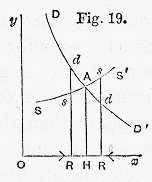
The counterargument relies on basic microeconomics. In a rational market, businesses will hire the number of employees that enables them to maximize their profits. If you are a profit maximizing home builder and you can profitably build and sell 100 homes a year, you’ll hire enough people to build 100 homes, spending as little on labor as you can. If you choose to build only 50 homes because you are afraid of the mandate in Obamacare, some other business will build the remaining 50 homes, and hire the people needed to do so. For an individual businesses, Obamacare will almost certainly have some effect on labor costs. For some, it may raise them, and for others, it may lower them. Economically speaking, though, there’s nothing special about it. Costs may go up due to higher fuel prices, or increased costs of lumber, or go down due to purchasing new equipment that makes home building more efficient. Operating a business is about understanding and managing costs.
As Mr. Puzder argues, one way to reduce costs is to shift full time workers to part time to avoid the requirement to provide employees with health insurance. While Obamacare may present business owners with another incentive to do so, this is hardly a new approach to cutting labor costs. There’s a lot of information in Fast Food Nation (published in 2001) about how fast food restaurants take advantage of a variety of labor regulations to save money, including keeping employees on part time status. What’s important is that the opportunity to switch employees from full time to part time is a luxury afforded to employers by the bad job market.
Obviously workers can quit their jobs any time and pursue better opportunities. The reason companies can cut their employees’ hours is that those opportunities are not available. Likewise, in a robust job market, replacing departing full time workers with part time workers would be much more difficult if the job market were better. Imagine what would happen if Google decided tomorrow to switch all of its engineers to part time positions with no benefits. They’d all have different jobs in no time and Google wouldn’t be able to find anyone to take their place.
Finally there’s the argument that Obamacare, and by that I mean providing health insurance for full time employees, will force companies to raise their prices. This is not how pricing works. Five Guys will charge as much as it can for a burger and fries, minimize its costs, and try to make a profit. Clearly higher costs that result from Obamacare (or anything else) may threaten the profitability of a business, but the idea of the new costs being passed directly on to the customers is just a scare tactic.
The economy has been in a sputtering recovery since it pulled out of the great recession of 2008. The result has been persistently high unemployment numbers and an epidemic of underemployment, along with a large migration of the long-term unemployed to long-term disability. For various reasons, the Federal Reserve, Congress, and even the White House have failed to come up with a coordinated response that has any hope of accelerating the recovery.
Most Republicans don’t even believe it’s possible for the government to address these kinds of economic problems in any effective way, and certainly aren’t open to supporting policies that might prove them wrong. In the end, they find it easier to scapegoat Obamacare rather than taking responsibility for their lack of a jobs policy of any kind.
The reason I bring this up is that being a free-market capitalist should be as much about understanding the free market as it is about yelling at the government to stop interfering with business. Convincing people that Obamacare is killing jobs is a huge obstacle to building a consensus for actually taking on our economic problems head on.


It’s not Obamacare, it’s supply and demand
A number of my Republican friends love to bring up the negative effect that Obamacare is having on workers. If you like theoretical arguments, there’s CKE Restaurants CEO Andrew Puzder arguing that Obamacare inevitably brings about a shift of full time workers to part time work. In a poll of 603 smallish business owners, 41% said they had frozen hiring because of Obamacare. For people who prefer to stick with anecdotal evidence, there’s a guy who owns Five Guys restaurants that says burger prices are going up because of Obamacare.
The counterargument relies on basic microeconomics. In a rational market, businesses will hire the number of employees that enables them to maximize their profits. If you are a profit maximizing home builder and you can profitably build and sell 100 homes a year, you’ll hire enough people to build 100 homes, spending as little on labor as you can. If you choose to build only 50 homes because you are afraid of the mandate in Obamacare, some other business will build the remaining 50 homes, and hire the people needed to do so. For an individual businesses, Obamacare will almost certainly have some effect on labor costs. For some, it may raise them, and for others, it may lower them. Economically speaking, though, there’s nothing special about it. Costs may go up due to higher fuel prices, or increased costs of lumber, or go down due to purchasing new equipment that makes home building more efficient. Operating a business is about understanding and managing costs.
As Mr. Puzder argues, one way to reduce costs is to shift full time workers to part time to avoid the requirement to provide employees with health insurance. While Obamacare may present business owners with another incentive to do so, this is hardly a new approach to cutting labor costs. There’s a lot of information in Fast Food Nation (published in 2001) about how fast food restaurants take advantage of a variety of labor regulations to save money, including keeping employees on part time status. What’s important is that the opportunity to switch employees from full time to part time is a luxury afforded to employers by the bad job market.
Obviously workers can quit their jobs any time and pursue better opportunities. The reason companies can cut their employees’ hours is that those opportunities are not available. Likewise, in a robust job market, replacing departing full time workers with part time workers would be much more difficult if the job market were better. Imagine what would happen if Google decided tomorrow to switch all of its engineers to part time positions with no benefits. They’d all have different jobs in no time and Google wouldn’t be able to find anyone to take their place.
Finally there’s the argument that Obamacare, and by that I mean providing health insurance for full time employees, will force companies to raise their prices. This is not how pricing works. Five Guys will charge as much as it can for a burger and fries, minimize its costs, and try to make a profit. Clearly higher costs that result from Obamacare (or anything else) may threaten the profitability of a business, but the idea of the new costs being passed directly on to the customers is just a scare tactic.
The economy has been in a sputtering recovery since it pulled out of the great recession of 2008. The result has been persistently high unemployment numbers and an epidemic of underemployment, along with a large migration of the long-term unemployed to long-term disability. For various reasons, the Federal Reserve, Congress, and even the White House have failed to come up with a coordinated response that has any hope of accelerating the recovery.
Most Republicans don’t even believe it’s possible for the government to address these kinds of economic problems in any effective way, and certainly aren’t open to supporting policies that might prove them wrong. In the end, they find it easier to scapegoat Obamacare rather than taking responsibility for their lack of a jobs policy of any kind.
The reason I bring this up is that being a free-market capitalist should be as much about understanding the free market as it is about yelling at the government to stop interfering with business. Convincing people that Obamacare is killing jobs is a huge obstacle to building a consensus for actually taking on our economic problems head on.